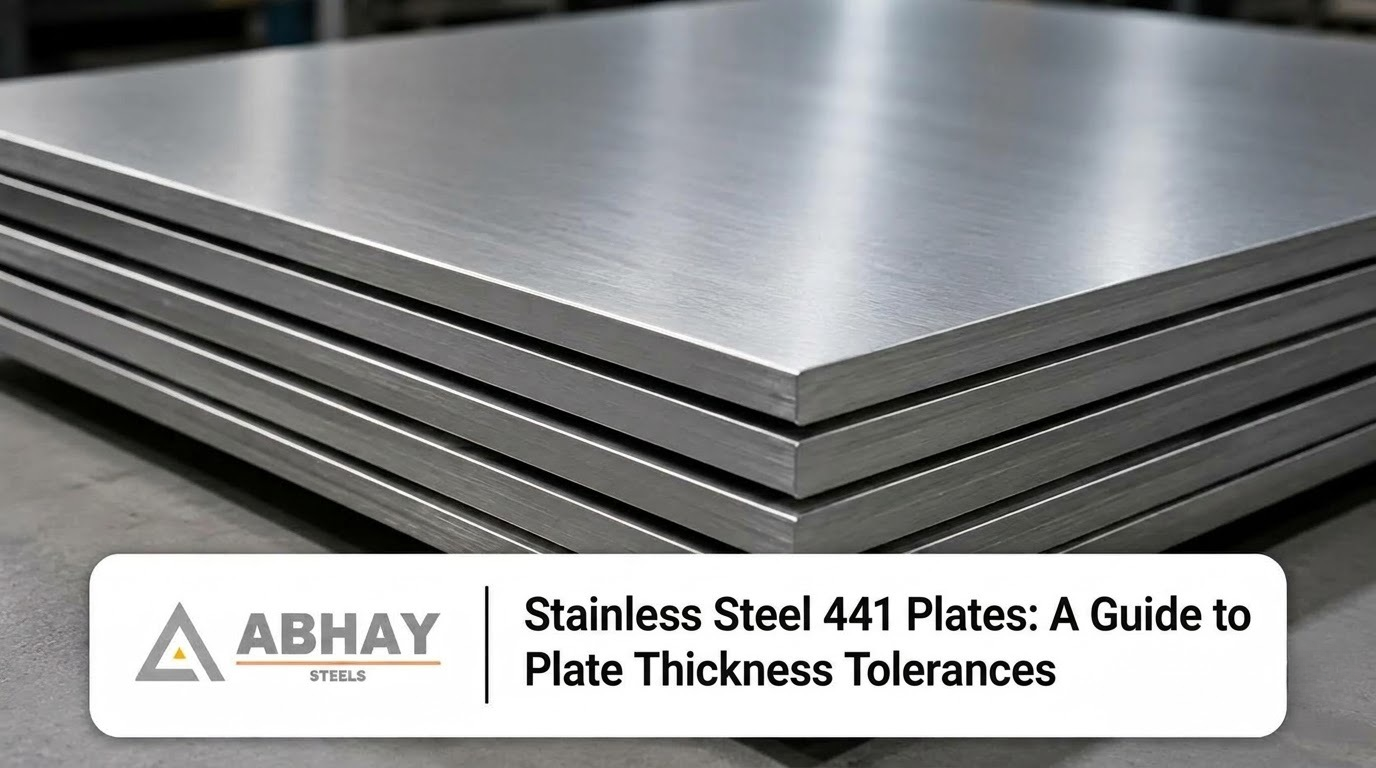
Rolled stainless steel plates are supplied to a nominal thickness, but no plate measures identically at every point across its surface. Mills work within a permitted range above and below that value, and the governing product standard defines this range. Fabricators cutting to close limits, weight estimators calculating tonnage, and machine shops setting up stock removal depend on that permitted range. For this reason, understanding the thickness tolerance of stainless steel 441 plates is essential when planning fabrication and material requirements.
What Is Stainless Steel 441 Plate?
SS 441 plate carries the UNS S44100 designation, a ferritic stainless steel grade stabilised against intergranular corrosion after welding with titanium and niobium. Manufacturers produce it to ASTM A240 for plate, sheet, and strip in general and moderate-temperature pressure applications, and European buyers have the same chemistry as 1.4509. Ferritic grades cost less than austenitic equivalents and resist thermal fatigue in cyclic heat service, which is why 441 stainless steel plates appear in exhaust and structural components.
What Does Plate Thickness Tolerance Mean?
Nominal thickness is the value on the mill certificate and purchase order. Rolling mills allow actual thickness to fall within a permitted band above or below that figure, and they define the allowance as a plus-or-minus variance. This band, the SS 441 thickness tolerance, occurs when hot and cold rolling fails to hold a uniform gauge across the plate. A related but separate limit, flatness tolerance, governs bow and wave.
What Determines Stainless Steel 441 Plate Thickness Tolerance?
Several variables determine the stainless steel plate thickness tolerance to a given order, and none work alone. Nominal thickness sets the starting point, since permitted variance often widens as the gauge increases. Plate width also matters, along with product form, since strip, sheet, and plate roll under different mill practices and tolerance tables. The manufacturing route, whether hot-rolled plate or cold-rolled strip, changes the capacity of a mill to hold consistently. The applicable material standard fixes the permitted range for that thickness and width, and the purchase specification can tighten it further on request. BSSA guidance on BS EN 10259 shows how strip tolerances scale with thickness and width, but that structure applies only to strip.
How to Check Thickness Tolerance on 441 Plates
Start by confirming the nominal thickness on the purchase order, since each subsequent check relies on that figure. Identify the product standard that determines the order, whether ASTM A240, ASME SA240, or an equivalent, because each defines its own tolerance structure. Locate the tolerance value that the standard publishes for that exact thickness and plate width. Measure the plate at multiple points using a calibrated micrometre or ultrasonic thickness gauge. Compare each measured value against the permitted range in the standard, and record the results with the gauge used in the material test documentation.
Why Thickness Tolerance Matters in Procurement
Thickness tolerance affects far more than a number on an inspection sheet. A plate at the low end of its tolerance leaves less material for machining allowance, which can push a finished part out of specification after stock removal. Weight estimates for freight and structural loading shift when actual thickness drifts from nominal, sometimes enough to affect quotations for large orders. Buyers ordering stainless steel 441 plates reduce these risks by specifying grade, nominal thickness, plate dimensions and the applicable product standard together.
Stainless Steel 441 Plate Thickness Tolerance: Buyer Checklist
Run through these checkpoints before confirming an order.
| Checkpoint | What to Verify |
| Grade | SS 441 / UNS S44100 |
| Nominal thickness | Purchase requirement |
| Plate dimensions | Length and width |
| Product standard | Applicable ASTM, ASME or EN standard |
| Thickness tolerance | Standard or agreed purchase tolerance |
| Inspection | Measurement and test documentation |
When ordering stainless steel 441 plates, specify the exact nominal thickness, plate dimensions, applicable product standard and required tolerance.
Contact our technical team to confirm plate dimensions, standards and thickness tolerance before you place an order.
Conclusion
Nominal thickness sets the target, but mill capability, width, and rolling method determine the extent to which actual gauge can drift within ASTM A240 or ASME SA240 limits. Verifying tolerance before cutting protects machining allowance and keeps weight calculations accurate. Specify the grade, dimensions, standard, and required tolerance together on every purchase order for SS 441 plates.