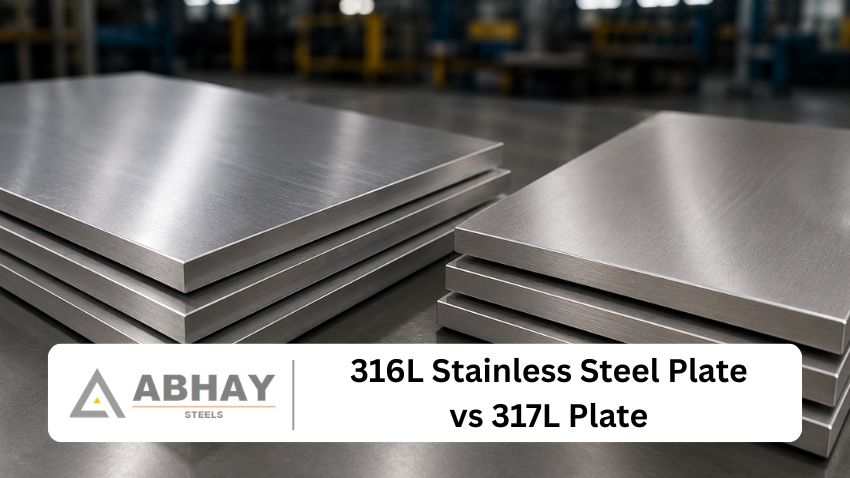
Austenitic stainless plates carry a lot of weight across chemical processing, marine fabrication, and food production. Two grades come up constantly in material selection meetings: 316L and 317L. Both resist corrosion and weld cleanly, but they are not interchangeable. A 316L stainless steel plate covers most general corrosive service, while 317L takes over once chloride and acid exposure gets aggressive. Knowing where that line sits saves a costly spec mistake before fabrication starts.
What Is a 316L Stainless Steel Plate?
316L is the low-carbon version of 316, with carbon capped at 0.03% against the standard 0.08%. That drop matters near weld seams, where carbon reacts with chromium and forms carbides that weaken corrosion resistance. The alloy carries 2 to 3% molybdenum, 16 to 18% chromium, and 10 to 14% nickel. It shows up in pharmaceutical tanks, food lines, and marine hardware facing moderate acid exposure.
Key Properties of 316L Stainless Steel Plate
316L brings a specific mix of traits that make it the default choice across many shops.
Corrosion resistance. Molybdenum resists chlorides and mild acids well, handling saltwater splash zones without quick pitting.
Weldability. Low carbon means thick sections weld without heavy post-weld treatment, and sensitisation risk drops sharply versus standard 316.
Mechanical strength. 316L posts a minimum yield strength near 170 MPa and tensile strength around 485 MPa, staying ductile after forming.
Low carbon content and reduced carbide precipitation. Minimal carbide formation resists intergranular attack at the heat-affected zone.
What Is a 317L Stainless Steel Plate?
317L runs on the same low-carbon platform but pushes molybdenum to 3 to 4%, with chromium at 18 to 20%. That extra molybdenum raises the pitting resistance number. Nickel also runs higher, between 11 and 15%. Plants running desulfurisation or bleaching lines specify 317L once 316L starts pitting in service.
Key Properties of 317L Plate
317L’s properties centre on one theme: performance, where 316L begins to struggle.
Enhanced pitting and crevice corrosion resistance: Higher molybdenum raises the pitting resistance number by roughly 4 to 5 points, extending life in tight crevices.
Improved chemical resistance: 317L tolerates sulfuric, phosphoric, and acetic acid concentrations that degrade 316L faster.
Excellent weldability: The low-carbon version welds without major sensitisation issues, using filler metals already common with 316L.
Performance in aggressive environments: The SS 317L holds mechanical integrity in continuous acidic, chloride-rich exposure, whereas 316L needs frequent inspection.
316L Stainless Steel Plate vs 317L Plate: Key Differences
The two grades share a family resemblance but diverge on points that matter once the plate is in service.
Chemical Composition Comparison
SS 317L consits of higher molybdenum, chromium, and nickel than 316L, while carbon remian capped at 0.03% in both, driving the performance gap.
Corrosion Resistance Comparison
316L resists general corrosion and moderate chlorides well. 317L pulls ahead in marine splash zones and acidic streams, usually after pitting on 316L.
Mechanical Properties Comparison
Both grades post similar yield and tensile strength since the core structure is close. 317L shows slightly better toughness at high temperatures.
Weldability and Fabrication
Both weld without heavy preheat. 317L needs closer interpass control on thick sections to preserve corrosion resistance at the weld zone.
Heat Resistance and High-Temperature Performance
The continuous working temperature of 316L is about 425℃. 317L is slightly more resistant to corrosion, but neither is really up to high heat.
Applications of 316L Stainless Steel Plate
Food processing, pharmaceutical, marine, and architectural sectors lean on 316L wherever moderate chloride exposure meets a need for formability.
Food and Beverage Processing
Processing tanks and mixing vessels use 316L because it resists organic acids and withstands caustic cleaning without pitting.
Pharmaceutical Equipment
Reactor vessels require 316L for its corrosion resistance and a surface that can withstand sterilisation is needed for contamination control.
Marine Components
Boat fittings and dock hardware use 316L for chloride resistance in splash zones, though fully submerged conditions push specifiers toward 317L.
Architectural and Structural Applications
Facades and handrails near coastal areas use 316L plate for its balance of strength and resistance to atmospheric corrosion.
Applications of 317L Plate
Chemical processing, pulp and paper, and pollution control industries specify 317L where process streams carry acids or chlorides that shorten 316L’s life.
Chemical Processing Plants
Reactor vessels handling concentrated acids use 317L, since standard 316L shows pitting within a few years under similar conditions.
Pulp and Paper Industry
Bleaching equipment exposed to chlorine-based liquors uses 317L because higher molybdenum resists the acidic, chloride-rich bleaching stages.
Pollution Control Equipment
Flue gas desulfurisation units use 317L because acidic condensate combined with chlorides creates the environment this grade was built for.
Offshore and Marine Processing Systems
Seawater injection systems use 317L, where continuous submersion demands more pitting resistance than 316L delivers.
How to Choose Between 316L Stainless Steel Plate and 317L Plate
Selection comes down to matching the grade against real operating conditions, not defaulting to whichever is familiar.
Evaluate the Corrosive Environment
Check chloride concentration and pH, and note whether exposure is continuous or intermittent. High chloride streams point toward 317L early.
Consider Operating Temperature
Higher temperatures accelerate corrosion regardless of grade. Factor sustained temperatures above 300°C into the decision.
Assess Fabrication and Welding Requirements
Both the grades are weld similarly, but thick 317L sections need tighter interpass control. Confirm with the supplier before ordering.
Balance Performance and Cost
317L costs more due to its alloy content. Where 316L already meets the corrosion demand, upgrading adds cost without adding value.
Advantages of Choosing the Right Stainless Steel Plate Grade
Getting the grade right at the design stage pays off across the equipment’s full operating life.
- Improved service life: Matching alloy content to actual exposure extends equipment life well beyond an undersized grade, cutting unplanned shutdowns.
- Reduced maintenance requirements: The need for inspections can reduce labour costs for plates that are resistant to pitting in their actual environment.
- Better corrosion resistance for specific environments: Choosing 317L for aggressive service instead of forcing 316L to handle it prevents premature failure.
- Enhanced operational reliability and lifecycle performance: A correctly specified plate cuts the risk of leaks or contamination events that disrupt production.
Common Selection Mistakes to Avoid
- The problem of selection errors can be traced to a few common procurement practices.
- If you replace an exact fit with a cheaper product, you may experience early corrosion problems and higher replacement costs down the road.
- Failure to consider corrosion severity and chemical compatibility leads to pitting and/or premature degradation of plates as compared to the project’s intended service life.
- Overlooking operating temperature conditions can push a grade past its safe corrosion range even when chloride levels seem manageable.
- Not considering fabrication and welding needs creates problems mid-project when a shop lacks experience with the specified grade’s welding parameters.
Conclusion
Both 316L and 317L have low-carbon, weldable base materials, but it is in the actual application that they are distinguished by their molybdenum content. The 316L can resist general corrosion in a variety of food, pharmaceutical, and structural environments. When chemical processing, pulp bleaching, and offshore systems have higher levels of chlorides and acids, 317L steps in. The selection between them is based on corrosion severity, operating temperature, fabrication requirements, and life cycle costs. The best way to ensure long-term performance is to review actual process conditions before using either grade.