Stainless steel decides how long food processing equipment lasts on the shop floor. Fabricators who build tables, panels, and machine covers require a material that cuts clean, forms without cracking, and resists daily contact with moisture and cleaning products. This is where the SS 430 slitting coil fits in. It is a ferritic grade, slit to precise widths from wider master coils, used because it balances corrosion resistance, formability, and cost for non-aggressive processing environments. Getting the specification right at sourcing affects hygiene, equipment life, and how smoothly a fabrication run goes.
What Is an SS 430 Slitting Coil?
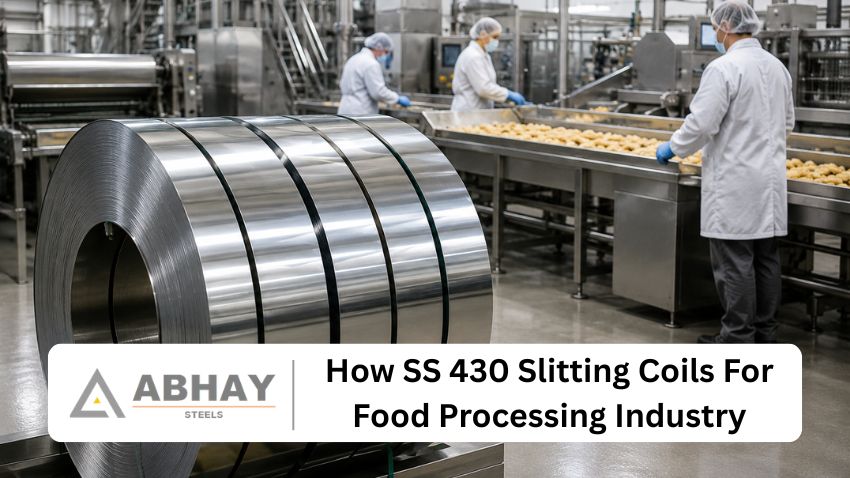
An SS 430 slitting coil starts as a wide master coil of ferritic stainless steel, is operated through a slitting line, and is cut into narrower, precise widths for fabrication. Grade 430 carries chromium without significant nickel, keeping cost lower than austenitic grades while giving usable corrosion resistance. It is magnetic and moderately ductile. Coils come in thin to mid gauge thicknesses, widths matched to forming lines, and 2B or BA finishes.
Key Material Properties of SS 430 Slitting Coil
The performance of this grade comes down to a few properties working together.
Chromium content sits around 16 to 18%, forming a passive oxide layer that self-repairs when scratched, resisting surface rust in dry to mildly moist conditions.
Formability stays good for a ferritic grade. Sheets bend, roll, and press into form without excessive springback, though draw depth stays shallower than 304.
Heat resistance can withstand moderate swings around ovens and steam lines without scaling.
The surface finish on a 2B or BA coil gives a smooth surface that resists residue buildup.
Why SS 430 Slitting Coil Is Suitable for Food Processing
Equipment
Material selection in food manufacturing affects sanitation compliance and cleaning frequency, not just strength. SS 430 meets the functional demands of most non-aggressive processing zones, where full austenitic resistance is not required but a hygienic surface still is.
Corrosion Resistance in Mild Food Processing Environments
Areas exposed mainly to water, general food contact, and standard detergents fall within what this grade handles reliably. It is not right where chlorides or acidic cleaners are used regularly.
Smooth Surface for Easy Cleaning and Hygiene
A flat, consistent finish reduces crevices where bacteria or food particles collect, so equipment wipes down fast with less scrubbing.
Excellent Formability for Equipment Components
Low rejection rates with slit coils bent into channel sections and conforming into panels without cracking at the bend radius.
Cost-Effective Alternative for Non-Aggressive Applications
This grade provides similar formability and hygiene, and at a lower cost, where full 304 or 316 resistance is not necessary.
Applications of SS 430 Slitting Coil in Food Processing Equipment
Slit coil from this grade is used in all types of equipment by fabricators ranging from load-bearing frames to cosmetic panelling.
Food Preparation Tables and Workstations
Tabletops, undershelves, and support frames use this coil since the surface withstands food contact without pitting.
Kitchen and Catering Equipment
Commercial sinks, backsplashes, and housings use slit coil stock for panels needing a hygienic finish.
Refrigeration and Cold Storage Components
Interior liners and structural panels benefit from stability across temperature cycling and condensation resistance.
Conveyor and Handling Equipment
Guide rails and side plates get formed from this coil where load requirements stay moderate.
Food Processing Machine Panels and Covers
This grade is used for machine housings and access panels to give a clean finish which is suitable for everyday wipe-downs.
Performance Benefits of Using SS 430 Slitting Coil
Several traits make this coil grade a repeat specification across food equipment programmes.
- Durability under daily handling stays consistent, resisting surface degradation without protective coatings.
- Dimensional accuracy from precision slitting provides consistent widths from coil to coil, keeping tooling running without adjustment.
- Maintenance requirements stay low because the passive layer limits staining.
- Oxidation resistance under moderate temperatures near ovens and steam equipment keeps the surface stable without scale.
- Reliability in dry and mildly corrosive zones holds up over repeated use, outside of contact with strong acids or chlorides.
Factors to Consider When Selecting an SS 430 Slitting Coil
Matching the coil specification to the equipment design avoids rework and fitment problems.
Coil Thickness and Width
The thickness must be equal to the load-bearing requirement, and the width to the forming line to minimise scrap.
Surface Finish Requirements
The 2B finish is for general components, and BA provides the brighter finish for components that are used in areas where hygiene is key.
Fabrication and Forming Needs
Bend radius, draw depth, and welding requirements determine whether formability holds up without cracking.
Operating Environment and Moisture Exposure
Intermittent water contact suits this grade well, while constant chloride exposure calls for a higher-alloy specification.
Fabrication Advantages of SS 430 Slitting Coil for Equipment Manufacturers
This grade is suitable for intermittent water contact; a higher alloy specification is suitable for constant chloride exposure.
- Manufacturers get practical advantages that affect throughput and part quality.
- The coil cuts, slits, bends, and forms without excessive tool wear, keeping die maintenance predictable.
- It runs on standard fabrication equipment already used for other stainless grades.
- Precision slitting maintains the same width and edge condition throughout large batches, which also helps to ensure quality.
- Manufacturing efficiency improves when slit widths match press requirements, cutting secondary trimming.
Best Practices for Maximizing the Service Life of SS 430 Slitting Coil Equipment
Equipment fabricated from this grade holds up longest when a few habits are followed.
- The use of mild detergents is recommended and should not involve the use of abrasive pads that will scratch through the passive layer.
- Contamination from corrosive chemicals, particularly standing chlorine-based cleaners, should be avoided since these attack the oxide layer.
- Systematic inspection will ensure that staining is identified in early stages and maintenance staff can address it by polishing, not replacing.
- Storage during fabrication should keep coil stock away from carbon steel, since cross-contamination can cause rust spots.
When SS 430 Slitting Coil Is the Right Choice for Food Processing Applications
This grade is best used in moderate conditions, meaning general food contact, water, and standard detergents, rather than sustained acid or chloride exposure. Structural panels, tabletops, and machine covers that need a hygienic finish and reliable forming without the cost of austenitic grades are good candidates. Where equipment sits in direct contact with brine, citrus acids, or chlorine sanitisers on a sustained basis, a higher-alloy grade becomes the safer specification. Reviewing actual operating conditions and cleaning regimes before finalising the coil grade keeps performance and budget aligned.
Conclusion
SS 430 slitting coil holds a steady place in food processing equipment manufacturing because it delivers durability, a hygienic surface, and forming behaviour suited to high-volume fabrication at a lower cost than austenitic alternatives. There are ways to decide the correct grade, but the environment in which the equipment operates determines the selection, as not all products require the same chemical resistance. This coil grade is a good selection to provide hygienic processing capabilities with a long service life for parts exposed to moderate conditions in food processing equipment manufacturers.