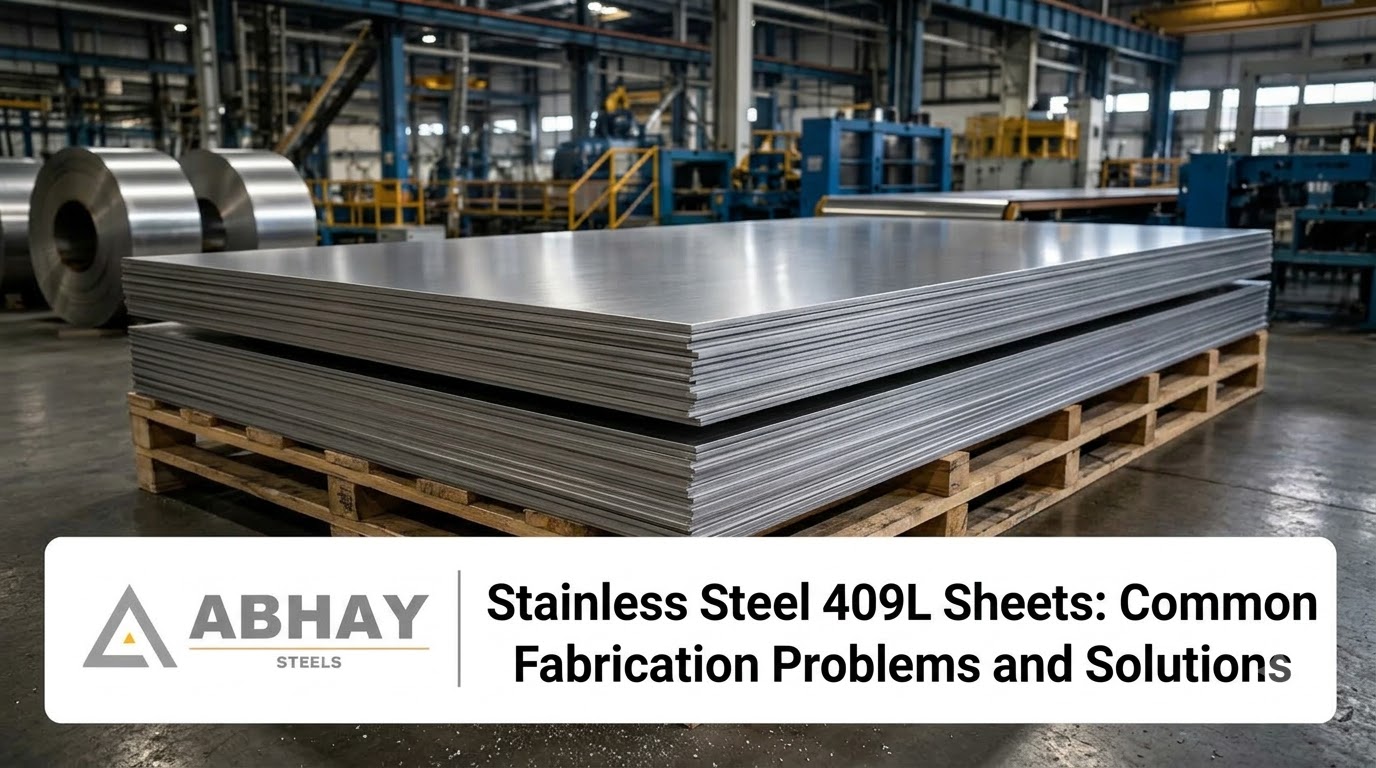
409L is a low-carbon ferritic stainless steel grade used in exhaust systems, silencers, and structural components where cost control matters alongside corrosion resistance. Its fabrication requires careful control of heat input, forming technique, and surface cleanliness to achieve consistent results. Unlike austenitic grades such as 304, its fabrication behavior requires different considerations because of its ferritic structure and low alloying content. These factors can influence weld quality, dimensional accuracy, and surface condition during manufacturing. Proper control of these variables is therefore important when working with stainless steel 409L sheets to produce reliable finished components.
Why Stainless Steel 409L Requires Specific Fabrication Practices
409L is a ferritic stainless steel, built around a body-centred cubic crystal structure rather than the austenitic structure found in 304 or 316. Carbon content stays near 0.03% maximum, with titanium added for stabilisation. This composition limits work hardening compared to austenitic grades, but it also reduces ductility at certain temperatures and raises sensitivity to grain growth under sustained heat. Welding and forming parameters for stainless steel 409L fabrication need tighter control than a generic workflow allows.
Common Fabrication Problems in 409L Sheets
Fabricators encounter five recurring issues when processing SS 409L sheets.
Welding distortion and excessive heat input
Uncontrolled heat during welding pulls the sheet out of shape and widens the heat-affected zone beyond what the joint design allows. Controlling amperage, travel speed and joint preparation keeps distortion and the heat-affected zone in check.
Grain growth in the heat-affected zone
Ferritic stainless steel coarsens under high-temperature exposure, which can affect toughness near the weld. Limiting heat input and avoiding repeated thermal cycles on the same joint reduce this risk.
Forming cracks
409L forms differently from austenitic sheet because it work-hardens less and tolerates less strain before cracking. Tooling, bend radii and forming speed suited to ferritic characteristics prevent surface and edge cracking.
Iron contamination
Carbon steel tooling, grinding wheels, or handling equipment shared with mild steel transfers free iron onto the surface, which subsequently appears as rust spotting. Dedicated stainless steel tooling and separate work areas prevent such contamination.
Weld discolorations and scale
Heat tinting and oxide scale form around the weld bead and affect appearance and corrosion resistance if left untreated. Post-weld cleaning restores the passive layer and removes scale.
Welding Problems and How to Prevent Them
409L stainless steel welding introduces variables beyond distortion and grain growth. Heat input needs to be controlled to match sheet thickness, since ferritic grades absorb heat differently than austenitic stainless steel and retain less ductility in the weld zone. Filler metal selection depends on joint design, the welding process in use and the service environment, so no single filler applies to every SS 409L welding problem. Minimizing thermal cycles by avoiding repeated tack welding or excessive weld passes protects the microstructure near the joint. Cleaning the joint area of oil, dirt and mill scale before welding prevents porosity, and following a qualified welding procedure, where required, keeps results consistent across production runs.
Forming, Cutting and Machining Considerations
Cutting stainless steel 409L sheets with excessive heat, whether from plasma, laser, or oxy-fuel processes, damages the material adjacent to the cut edge and can affect corrosion resistance there. Matching the cutting method and speed to sheet thickness limits this damage. Forming operations should reflect the lower ductility of ferritic stainless steel compared to austenitic grades, which means tooling, die clearance and bend allowances need adjustment. Machining 409L requires sharp tooling and parameters matched to material condition and equipment, since dull tooling accelerates work hardening at the cut surface.
Practical Solutions for Better 409L Fabrication
The table below summarizes practical controls for the fabrication issues covered above.
| Fabrication Issue | Practical Control |
| Welding distortion | Control heat input and welding sequence |
| Grain growth | Minimize excessive thermal exposure |
| Forming defects | Use suitable tooling and forming parameters |
| Iron contamination | Use clean, dedicated stainless steel tooling |
| Weld discoloration | Apply appropriate post-weld cleaning |
| Surface damage | Protect sheets during handling and fabrication. |
Applying these controls consistently across a production run reduces rework and keeps finished parts within the tolerances a project specification demands.
Successful fabrication of stainless steel 409L sheets comes down to four controllable variables: heat input, forming technique, surface cleanliness, and post-weld treatment. None of these replaces a project specification. Weld parameters, filler selection, and forming allowances should follow the component design, the welding process, and the applicable standard.