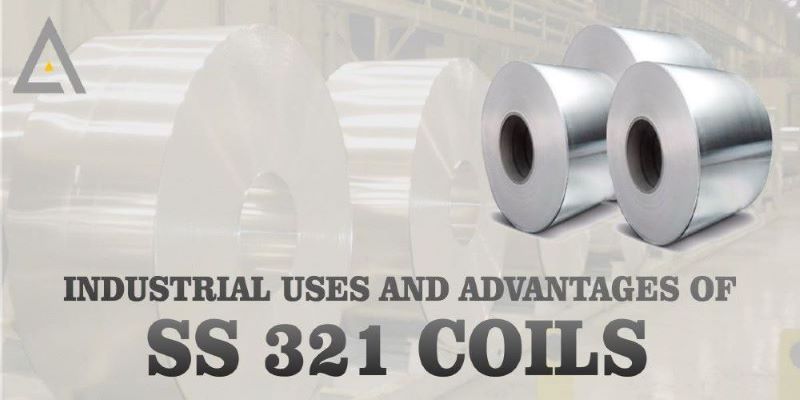
Stainless Steel 321 is titanium-plated austenitic stainless steel with greater overall corrosion resistance. It has a remarkable inter granular tolerance to corrosion at temperatures of 800–1500 degrees F (427–816 degrees C) in chromium carbide precipitation.
Stainless Steel 321 Coils maintain oxidation at 1500 degrees F (816 degrees C) and have better creep and stress rupture efficiency than SS 304 and 304L. It also maintains strong low-temperature longevity.
Stainless Steel 321H is the higher carbon variant (0.04–0.10) of the SS 321. It was developed to increase creep resistance and higher resistance at temperatures above 1000 degrees F (537 degrees C). In most cases, the carbon content of the plate allows dual certification.
SS 321 cannot be hardened by heat treatment, but rather by cold service. Standard engineering processes can be easily welded and stored.
Stainless Steel 321 Coils Characteristics
• Oxidation tolerance up to 1600 degrees F
• Intergranular corrosion stabilized against welded heat-affected zone (HAZ)
• Tolerance to polythionic acid stress corrosion cracking
Applications for SS 321/321H Coils
• Aircraft engine piston manifolds and exhaust stacks
• Mutual extension
• Thermal oxidizers
• Refining machinery
• High-temperature chemical process facilities
• Food processing and distribution facilities
Resistance to corrosion
Stainless Steel 321 Coils have a good overall corrosion resistance that is close to 304. It was produced for use of chromium carbide precipitation by 1800–1500 degrees F (427–816 degrees C) where unstabilized alloys, such as 304, are subject to intergranular assault. The alloy can be found with most diluted organic acids at moderate temperatures and in pure phosphoric acid at lower temperatures and up to 10% diluted solutions at high temperatures. Stainless Steel 321 Coils are resistant to polythionic acid stress corrosion cracking in the hydrocarbon operation. It can also be found in caustic solutions free of chloride or fluoride at low temperatures. SS 321 does not perform well in chloride solutions, either in limited amounts or in the sulphuric acid operation.
Machining up
304 Stainless Steel is not tougher than 321 stainless steel, which creates the same tough stringy chips. Work-hardening; sluggish speeds and thick feed minimizes the inclination of this alloy.
Welding & Welding Processes
321 Stainless steel is quickly welded to all traditional methods, including submerged arc. Suitable weld fillers are most commonly referred to as AWS E/ER 347 or E/ER 321. This alloy is commonly considered to have comparable weldability to 304 and 304L stainless steel, with the prime difference being the addition of titanium which eliminates or prevents precipitation of carbide during welding.
Annealing at 1800-2000 degrees F (928-1093 degrees C) cold temperature. This method would result in the highest ductility possible. See note on fixed anneal under corrosion for optimum corrosion resistance. Stainless Steel 321 Coils cannot be hardened by heat treatment. High properties can only be accomplished by cooling down.
Hot-working and cold working methods
Working temperatures between 2100-2300 degrees F (1149-1260 degrees C) are recommended for forging, disturbing, and other hot job processes. Do not work 321 Stainless Steel Coils at temperatures below 1700 degrees F. The substance must be water-quenched or fully annealed to maintain the highest resistance to corrosion.
While this material demands higher initial forces than 304 stainless steel, it is marginally rugged and ductile and can be quickly stamped, blanked, spun, and drawn.