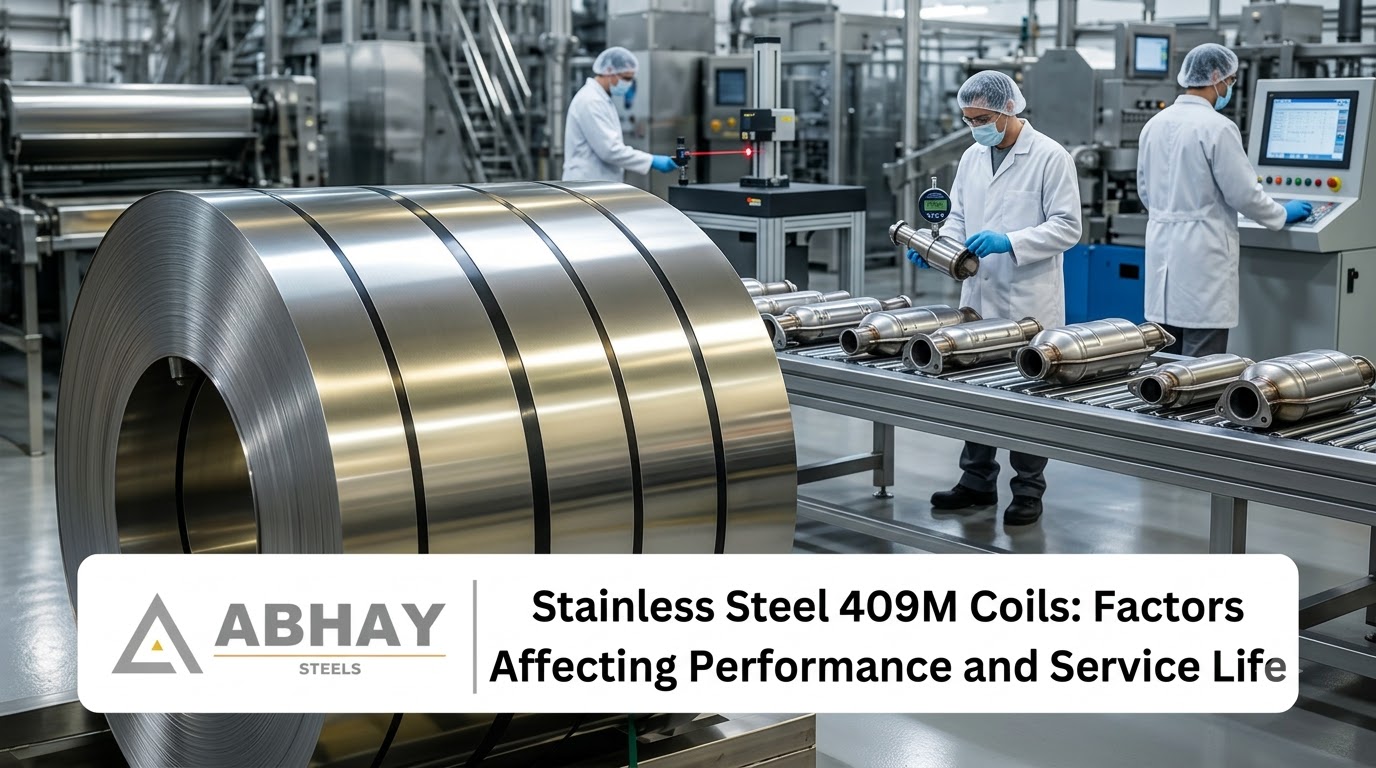
Stainless steel 409M coils perform best when matched to the right application. Their service life depends on how well the coil’s characteristics align with operating conditions. Proper material selection helps support reliable performance throughout the intended service period.
Factors Affecting Stainless Steel 409M Coil Performance
Material Characteristics and Service Conditions
SS 409, identified under UNS S40900 and EN 1.4512, belongs to the ferritic family of stainless steels and is typically supplied in a stabilized condition. This structure provides a balance of corrosion resistance, oxidation resistance, and formability that differs from austenitic grades.
409M stainless steel coils based on this grade should be selected according to the conditions in which the material will operate. The required properties should be evaluated against the application’s temperature, environment, fabrication requirements, and expected service conditions.
Temperature and Oxidation Exposure
Heat exposure can affect stainless steel behavior over time. Type 409 is used where elevated-temperature service and oxidation resistance are required. Repeated heating and cooling cycles can place stress on the protective oxide layer.
The service atmosphere can also affect oxidation behavior. Confirm the expected operating temperature against verified material data before finalizing a stainless steel 409M coil order.
Corrosion and Environmental Exposure
The service environment can have a significant effect on coil performance. SS 409 offers improved corrosion resistance compared with plain carbon steel. This is one reason it is used in automotive exhaust systems and other non-automotive applications.
Moisture, airborne contaminants, and atmospheric exposure can affect the surface differently. Maintenance requirements also vary with the environment. SS 409 is not suitable for every aggressive chemical process or marine-splash environment. Chloride exposure and strong-acid conditions therefore require assessment before material selection.
Forming and Fabrication
The forming process can affect the performance of the finished component. SS 409 offers formability suitable for operations such as bending, roll forming, and cutting.
Fabrication practices should match the material and component design. Tight bend radii and improper cutting can introduce stress points. Suitable fabrication methods help maintain dimensional accuracy and support consistent component performance.
Welding and Heat-Affected Areas
Welding introduces concentrated heat into the material. As a result, the heat-affected zone can behave differently from the surrounding parent metal.
The welding procedure should suit both the grade and the service conditions of the finished component. Fabricators working with SS 409M coils should confirm welding procedures against verified guidance for the specific application rather than relying on generic parameters.
Surface Condition and Finish
Available finishes include hot rolled, cold rolled, 2B, 2D, BA, No. 8, and satin. Each finish provides a different balance of appearance, formability, and surface characteristics.
No single finish is suitable for every application. A 2B finish may suit structural requirements. BA or No. 8 finishes may be considered where surface appearance or cleanability is important. The finish should therefore be selected according to the application’s requirements.
Thickness, Dimensions and Coil Processing
Coil dimensions affect fabrication and the final component design. Thickness ranges from 0.31 mm to 12.7 mm, covering applications from light sheet metal work to heavier forming requirements.
Width requirements should be confirmed against current stock and project specifications at the time of ordering. Where narrower material is required, slitting and cut-to-size processing can help match the coil dimensions to the final design.
Quality Control and Material Documentation
Material verification is an important part of procurement. SS 409 coils are typically supplied against ASTM A240 or ASME SA240.
Depending on the application and purchase specification, testing options can include PMI, hardness, IGC, impact, flaring, and flattening tests. Standard mechanical and chemical testing may also be required. Mill test certificates to EN 10204 3.1B can be requested where applicable.
Not every test applies to every order. Testing requirements should therefore be confirmed according to the project specification rather than assuming that the complete test list is required.
Maintenance and Service Life
Long-term performance depends on conditions after installation as well as the original material specification. Regular inspection can identify surface changes before they develop into more serious problems.
Cleaning schedules should suit the service environment. Appropriate cleaning can help limit contaminant buildup that may accelerate degradation. Keeping the component within its specified operating conditions is also important for maintaining long-term performance.
Choosing Stainless Steel 409M Coils
Several factors influence the performance and service life of stainless steel 409M coils. These include operating temperature, oxidation exposure, corrosion conditions, fabrication, welding, surface finish, coil dimensions, material documentation, and maintenance.
The specification should be established according to the intended service conditions before procurement. This helps ensure that the selected coil meets the application’s performance and fabrication requirements.
Stainless steel 409M coils from Abhay Steels are available across standard thickness and finish options for engineering, construction, and industrial applications. Contact Abhay Steels to discuss the specifications required for your stainless steel 409M coil requirement.